Mile 19: Diversey to Addison
This painting is a part of my Western Avenue Series, through which I'll be making 24 watercolor paintings, one to document each mile of Western Avenue, in Chicago. I started this project because while it is not considered to be among the most “beautiful” of Chicago’s streets, Western Avenue is a perfect place to document the humanness of Chicago, the positive and the negative. In the words of Stuart Dybek, "Western, with apologies to State Street, is a great street, Unlike State, it is a street that goes to the interior, the heart of the city, as it glides and glows through a United Nations of neighborhoods." Check back next Monday to see a post about the next mile of Western.
A viaduct is defined as a long bridgelike structure, typically a series of arches, carrying a road or railroad across a valley or other low ground. The Viaduct Theater in Chicago, which was established in 1998 is quite literally located under a viaduct that runs over Western Avenue. It is tucked under the viaduct, just south of Belmont in a bit of an out-of-the-way location. In fact, a number reviews of the theater note that it can be a bit hard to find. I was charmed by the unexpectedness of the location and the opportunity to bring life to otherwise, sparsely used portion of Western Avenue.
The viaduct theater provides a forum for theater, film, art, dance, and music. People describe theater as intimate, but not cramped. One reviewer said that, "the front rows were closer to the front of the stage than I've ever seen before." The space has been described as "hole-in-the-wall-ish," "feels grungy but it is very clean," and "a bit industrial."
I was entirely charmed by the theater and hope to see a performance there sometime soon.
Have you been to the viaduct theater?
Monday, March 19, 2012
Sunday, March 11, 2012
Western Avenue Series
Mile 19: Diversey-Addison
This sketch is a part of my Western Avenue Series, through which I'll be making 24 watercolor paintings, one to document each mile of Western Avenue, in Chicago. I started this project because while it is not considered to be among the most “beautiful” of Chicago’s streets, Western Avenue is a perfect place to document the humanness of Chicago, the positive and the negative. In the words of Stuart Dybek, "Western, with apologies to State Street, is a great street, Unlike State, it is a street that goes to the interior, the heart of the city, as it glides and glows through a United Nations of neighborhoods." Check back next Monday to see the painting completed based on this sketch.
This stretch of Western is a bit unusual because where the Avenue crosses the North Branch of the Chicago river. there is a bridge and a long stretch of overpass. The overpass creates two levels of street, cars whiz along the upper section, while the lower section is a dark forest of concrete columns with small structures lining the street.
The Riverview Amusement park, which opening in 1904 and operated for more than six decades, was once located along this section of Western. Riverview was the last of big amusement parks that once dotted Chicago. At its close it had 120 ride, including six rollercoasters, a parachute jumps and rockets.
Just north of where Riverview once stood, is Lane Tech High School, which began in 1905 as the Thomas Hoyne Manual Training High School. Today it is one of Chicago's public college prep high schools and home to eleven beautiful WPA murals.
Have you seen the beautiful Lane Tech murals?
Monday, March 5, 2012
Western Avenue Series
Mile 18: Armitage to Diversey
This painting is a part of my Western Avenue Series, through which I'll be making 24 watercolor paintings, one to document each mile of Western Avenue, in Chicago. I started this project because while it is not considered to be among the most “beautiful” of Chicago’s streets, Western Avenue is a perfect place to document the humanness of Chicago, the positive and the negative. In the words of Stuart Dybek, "Western, with apologies to State Street, is a great street, Unlike State, it is a street that goes to the interior, the heart of the city, as it glides and glows through a United Nations of neighborhoods." Check back next Monday to see a post about the next mile of Western.
The subject of this painting is Revolution Tattoo & Art Gallery. Revolution caught my eye because it is both elegantly detailed, with checker-board brickwork and colorfully adorned by intricate window signage. Not only that, I was intrigued by the fact that it is both a tattoo shop and an art gallery. Revolution is the brainchild of Cheri Basak and Omar Gutierrez. According to their website, "They wanted to provide an ever-changing, creative environment for themselves and more importantly, their clients. Most of the artwork shown and sold here is illustrative, usually low-brow, religious, sexual, sometimes controversial, and for obvious reasons, tattoo related." The gallery has been in operation since 2002, featuring many local fine artists and tattoo artists.
I love the idea of increasing the accessibility of art, by showing the work of artists in unexpected places, like tattoo shops.
What is the most interesting formal or informal "gallery" space you know?
Sunday, February 5, 2012
Western Avenue Series
Mile 17: Division to Armitage
This painting is a part of my Western Avenue Series, through which I'll be making 24 watercolor paintings, one to document each mile of Western Avenue, in Chicago. I started this project because while it is not considered to be among the most “beautiful” of Chicago’s streets, Western Avenue is a perfect place to document the humanness of Chicago, the positive and the negative. In the words of Stuart Dybek, "Western, with apologies to State Street, is a great street, Unlike State, it is a street that goes to the interior, the heart of the city, as it glides and glows through a United Nations of neighborhoods." Check back next Monday to see a post about the next mile of Western.
This painting is complete though the documenting of it (as is apparent from the hole in the center of the image) is not! The subject of this painting is the Western Avenue Blue Line station, located just south of Armitage. This station opened in 1895 as part of the Metropolitan Elevated's Logan Square branch. In 1930 an Art Deco style façade replaced its original station entrance. I wanted to paint this station because the I find it be quite elegant. It's a familiar stop, with several favorites of mine, particularly Margies, which I mentioned in the previous post, as well as Belly Shack (owned by the same folks at Urban Belly), and Green Eye.
Click here to purchase this painting.
Do you have a favorite El station in Chicago?
Next stop, Revolution Tattoo, stay tuned!
This painting is a part of my Western Avenue Series, through which I'll be making 24 watercolor paintings, one to document each mile of Western Avenue, in Chicago. I started this project because while it is not considered to be among the most “beautiful” of Chicago’s streets, Western Avenue is a perfect place to document the humanness of Chicago, the positive and the negative. In the words of Stuart Dybek, "Western, with apologies to State Street, is a great street, Unlike State, it is a street that goes to the interior, the heart of the city, as it glides and glows through a United Nations of neighborhoods." Check back next Monday to see a post about the next mile of Western.
Click here to purchase this painting.
Do you have a favorite El station in Chicago?
Next stop, Revolution Tattoo, stay tuned!
Sunday, January 29, 2012
Western Avenue Series
Mile 17: Division-Armitage
This sketch is a part of my Western Avenue Series, through which I'll be making 24 watercolor paintings, one to document each mile of Western Avenue, in Chicago. I started this project because while it is not considered to be among the most “beautiful” of Chicago’s streets, Western Avenue is a perfect place to document the humanness of Chicago, the positive and the negative. In the words of Stuart Dybek, "Western, with apologies to State Street, is a great street, Unlike State, it is a street that goes to the interior, the heart of the city, as it glides and glows through a United Nations of neighborhoods." Check back next Monday to see the painting completed based on this sketch.
As I continue my way down Western Avenue, I am beginning to reach portions of the Avenue which are more familiar to me. The stretch between Division and Diversey continues to be heavily commercial though there is a smattering of residences.
I was particularly taken with this small single family home, whose future seems to be in jeopardy. It's quaintness is accentuated by the contrast with the adjacent commercial buildings and larger residential structures.
Certainly, my favorite place to visit along this stretch of Western is Margie's Candies. Margie’s an old-fashioned ice cream. It is notable for having been patronized by Al Capone in its early years and, in 1965, the Beatles after having played a concert at Comiskey Park. Especially, it just has great ice cream. I almost always get a chocolate malt and find the waffle cookies they give you on the side strangely wonderful. The menu is quite extensive, with over fifty varieties of sundaes, including the the twenty-five scoop Royal George (named after founder George Poulos).
Do you have a favorite sundae at Margies?
Monday, January 23, 2012
Western Avenue Series
Mile 15: Kinzie-Division
This painting is a part of my Western Avenue Series, through which I'll be making 24 watercolor paintings, one to document each mile of Western Avenue, in Chicago. I started this project because while it is not considered to be among the most “beautiful” of Chicago’s streets, Western Avenue is a perfect place to document the humanness of Chicago, the positive and the negative. In the words of Stuart Dybek, "Western, with apologies to State Street, is a great street, Unlike State, it is a street that goes to the interior, the heart of the city, as it glides and glows through a United Nations of neighborhoods." Check back next Monday to see a post about the next mile of Western.
At long last I have completed the next painting in the Western Avenue Series. A series of obligations related to my studio facilitation at Archeworks, the holidays, and social obligations resulted in a stagnation in my progress. I hope to return to more regular schedule now and I'm excited to have completed two thirds of the paintings and to be drawing closer to the portions of Western Avenue with which I am most familiar.
It was a delight to paint this classic old car dealership with it's colorful signage and surprisingly unimpressive collection of used cars for sale. There are 70 new and used car dealerships located on Western, so I knew that I wanted to include one in the collection.
Friday, December 2, 2011
Featured Artist
Susan Spohn
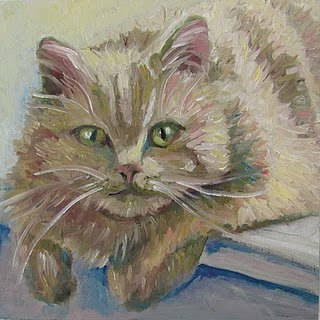
Susan paints in oils and is a colorist who is also interested in the thick textures obtained using a pallet knife. A Colorado artist, Susan presently resides in the small town of Salida, Colorado, located in the Arkansas Valley surrounded by mountains and valleys, rivers, forests, lakes, and tourists. Residing in an old brick building in the historic district, she has a small, porch-like enclosed studio on the second floor, overlooking the back alleys near downtown.
What interests you about painting animals?
I mainly do not paint animals... only in this small format as part of my daily painting routine, and now, I also do pet portraits in this 7 x7 format. (and I am now taking orders for the Christmas gift time) I really like animals. I think they are all beautiful. I never know 'how' I am going to paint them. I just start painting and they sort of paint themselves, with only a few complications that I need to solve along the way. I do not use black or any earth tone paint on my pallet. I mix all of these colors. This keeps my colors more vibrant, and at the same time creates more mixing work for me! As an example, a cat I painted, was painted entirely using sap green, and sap green mixed with other colors. The finished cat painting looked creamy with a touch of orange; just as the original photo suggested.
Are there particular artists who influence your work?
When I am participating at an art show with my other paintings (florals, treescapes), most folks see a strong influence post-impressionistic painters in my style; especially, Vincent Van Gogh It always amazes me, since I do not consciously study Van Gogh or think about his painting style when I paint. I feel I am an emotional painter, letting my instincts control the paintings more than a photo reference or perhaps rules of the art world. I appreciate all painters with a looser painting style. And my pet portraits and animal paintings are about as 'tight' as I get in my painting style, my other paintings are much looser.
Are there new themes or mediums you anticipate exploring in your upcoming work?
I am now working on some oil and mixed media pieces in a more abstract style. I can envision a series of these in the future. In addition, I see my floral pieces becoming even looser and more abstract. I will continue painting my small animal and pet portraits; they are a wonderful creative exercise and I never know how they will turn out.
What do you think of Susan's work?
Susan paints in oils and is a colorist who is also interested in the thick textures obtained using a pallet knife. A Colorado artist, Susan presently resides in the small town of Salida, Colorado, located in the Arkansas Valley surrounded by mountains and valleys, rivers, forests, lakes, and tourists. Residing in an old brick building in the historic district, she has a small, porch-like enclosed studio on the second floor, overlooking the back alleys near downtown.
What interests you about painting animals?
I mainly do not paint animals... only in this small format as part of my daily painting routine, and now, I also do pet portraits in this 7 x7 format. (and I am now taking orders for the Christmas gift time) I really like animals. I think they are all beautiful. I never know 'how' I am going to paint them. I just start painting and they sort of paint themselves, with only a few complications that I need to solve along the way. I do not use black or any earth tone paint on my pallet. I mix all of these colors. This keeps my colors more vibrant, and at the same time creates more mixing work for me! As an example, a cat I painted, was painted entirely using sap green, and sap green mixed with other colors. The finished cat painting looked creamy with a touch of orange; just as the original photo suggested.
Are there particular artists who influence your work?
When I am participating at an art show with my other paintings (florals, treescapes), most folks see a strong influence post-impressionistic painters in my style; especially, Vincent Van Gogh It always amazes me, since I do not consciously study Van Gogh or think about his painting style when I paint. I feel I am an emotional painter, letting my instincts control the paintings more than a photo reference or perhaps rules of the art world. I appreciate all painters with a looser painting style. And my pet portraits and animal paintings are about as 'tight' as I get in my painting style, my other paintings are much looser.
Are there new themes or mediums you anticipate exploring in your upcoming work?
I am now working on some oil and mixed media pieces in a more abstract style. I can envision a series of these in the future. In addition, I see my floral pieces becoming even looser and more abstract. I will continue painting my small animal and pet portraits; they are a wonderful creative exercise and I never know how they will turn out.
Many thanks to Susan for sharing her lovely paintings!
Subscribe to:
Posts (Atom)


